
Showing posts with label sodium. Show all posts

Unrealistic Serving Sizes or Unrealistic Consumers?


On Tuesday I was contacted by Good Morning American to tape a segment on serving sizes. I shuffled my afternoon calendar and made my way over to Fairway Market to meet their crew. The news of the day involved a request by CSPI (often referred to as the food police) asking the FDA to revise serving sizes on certain food labels. I was interviewed in various aisles and went back to my office.  I watched the show the next morning and later contacted the producer; I thought I had missed the nutrition segment. She apologized to me and explained the story “had been bumped for the peacock.” The peacock being the one who had escaped from the Central Park Zoo. Serving sizes would wait another day.

The segment did air yesterday but my gripping comments about soup and cooking spray were cut to about the length of time the label suggest you spray (or a ¼ second) so I’ll fill you in. CSPI feels that the labels for certain foods such as the aforementioned canned soup, cooking spray as well as ice cream and coffee creamer (not a particularly healthful foursome) underestimate the actual amount of these foods consumers use. It’s hard to argue that one-cup of soup, an actual cup not a restaurant mug is pretty teensy and measuring ¼ second as aerosol oil sprays  suggest on the label is silly. I mean, “one-Mi” if we’re using the exact science of Mississippi counting.  So yes, the labels have their faults but perhaps consumers of canned soup, ice cream, spray oil and coffee creamer have bigger fish to fry.

While the serving size may be a little off, all labels list “servings per container.” So to determine just how much of a sodium bomb your Chicken Noodle soup is you need to multiply the serving by a factor of 2 or 2.5. Are we unsure consumers can do this?  CSPI is worried about people with hypertension, I am too. Should people who care about their blood pressure be eating canned soup? Or, are they reassured by the 790 milligrams if they eat the suggested 1-cup serving? I am all for pointing out confusing and misleading food packages but don’t see this as all that misleading.

CSPI suggests “the FDA should define serving sizes to reflect what consumers actually eat.” To me that’s opening up an extra large can of worms. With that reasoning is a serving size of frozen pizza one pie? A pint of ice cream? A liter of soda? CSPI found on a phone survey that most Americans do not consume 1 cup of soup, can we use what people actually eat to formulate guidelines? I don’t think so.  

Food companies know what’s going on. Chips would be less attractive if calories per bag were listed. “One hundred calories per serving” sounds much better, too bad if there are 25 servings in the bag. So there’s a little fudging in on the part of the companies but who are we kidding when we down the bag of chips? So while I know most people don’t have a “teacup” of cold cereal, if you eat fewer packaged foods you’re in a better place for a host of reasons.  And in case you are more interested in the peacock story, here it is.
Do you think serving sizes are “misleading”? Do you think they should, as CSPI requested, reflect what consumers actually eat? Do you eat any of the four foods mentioned?




10 Sneaky Sources of Salt


We all have a friend or family member who, like my husband, often reaches for the saltshaker even before tasting their food. Perhaps this person is chided for their overzealous shaking; perhaps not. But the truth is that even the most serious salt-lover isn’t in danger of approaching the recommended one-teaspoon-a-day of salt from that habit. Instead, have you ever considered criticizing the amount of spaghetti sauce someone uses? Maybe you should.” Here are ten sneaky salt sources lurking in your food from a post I wrote for Blisstree.
 Chicken Breast
And I’m not talking about fried chicken or chicken tenders, either. Most supermarket chicken breasts are injected with a sodium solution. One serving of that can contain 400 mg of sodium (raw!), while less than 100 mg of sodium are naturally found in chicken. I first learned about this from Janet Helm’s Nutrition Unplugged post and have been disturbed ever since.
Medications
You have PMS, so you pop an NSAID (non-steroidal anti-inflammatory drug) to help relieve your cramps. But many NSAIDS (like ibuprofen) are high in sodium, which is a concern for those with high blood pressure or high “bloat.” A salt pill won’t likely help improve your moodiness once you realize that.

Baked Goods
Muffin with your salt? A Starbucks low-fat red raspberry muffin contains 500 mg of sodium, but at least that’s 400 mg less than the 900 mg in its egg white, spinach, and feta wrap. Either way, go easy on the baked goods.

Tomato Sauce
You may obsess about the carbs loaded in your bowl of pasta, but have you contemplated the sauce? Tomatoes are full of lycopene, a powerful antioxidant; tomato sauce also contains lycopene – and a lot of salt. A cup of tomato sauce (no meatballs) contains almost 1,500 mg of sodium. For less salt, make the sauce yourself using fresh tomatoes (yes, less convenient).
Deli Sandwiches
It’s no surprise that processed meats are salty. However, at delis, the meat, bread, and “extras” also contribute salt. A 6” Subway turkey breast sandwich has 910 mg of sodium. American cheese adds 200 mg and pickles another 125 mg, for a grand (or not so grand) total of 1,235 mg of sodium. How’s Jared’s blood pressure doing?

Canned Beans
You’ve probably considered the serious salt in canned soups, but what about your beans? Those that come from a can will run you more than 700 mg of sodium per cup (or 1/3 of your daily allowance). If you eat beans at home, give them a rinse in a colander or buy low-sodium beans. Better yet: Soak and cook your own.

Raisin Bran Cereal
You know that fiber is a good-for-you whole grain, and we all need more of it in our diets. Problem is, salt and sugar are often added to processed whole grains to spice them up. One culprit is raisin bran cereal, with 342 mg sodium per cup (plus a whole lot of sugar).

Bottled Salad Dressing
Just two tablespoons of bottled Italian salad dressing contain almost 500 mg of sodium. (And two tablespoons is not a lot.) Pair that with the aforementioned beans, plus some olives or roasted peppers and now you know why you feel bloated after hitting the salad bar. Foodtrainers’ favorite dressing olive oil and lemon juice.

Cottage Cheese
When you mention “diet” foods, many people’s heads fill with images of cottage cheese, Melba toast, and Kellogg’s Special K cereal. But cottage cheese is certainly not a low-sodium diet food. Just one cup contains 900 mg of sodium, so you may want to rethink breakfast (just not with raisin bran).

Ketchup
Those cute little packets look so harmless, especially compared to the fries next to them. But just one tablespoon of this adorable condiment means 190 mg of sodium. Add the fries, and you’re well over 500 mg.

The moral of the story is to read labels and check out the sodium. You don’t want your day’s food composed of many serious sodium sources, the same can be said for your children’s food. Which of these items was the biggest surprise? Do you consider yourself salt sensitive? Any strategies, other than making yourself to cut salt?


Soup-er

It’s not easy to list your good qualities and I’m not about to start. I will say that I am not a whiner. Whether it’s pain,emotional or physical, or discomfort, I have a high threshold. This serves me well in the ski season. My husband always says, referring to our kids, “skiing will toughen you up, anyone can sit on a beach.” Let’s just say on Sunday, I was craving some beach time. I was wearing many layers and hand warmers, cashmere socks and a neck gator and I was still cold. I may have even whined a little. I didn’t whine that much though because I didn’t last that long. It was bitter and windy, the tips of my fingers couldn’t grip my poles…aren’t you jealous of our ski weekends?

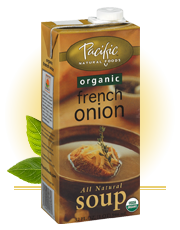
My husband was not cold (and was so proud of this fact) and my boys do not finish until 12:45 so I headed home for a bit to warm up. I wasn’t ready for lunch but I was ready for warmth. I scanned our soup selections and perked up when I saw something I hadn’t tried before.  It was this:

I poured some of this French Onion Soup into a pot and heated it up.  I would normally have been giddy with anticipation was I was still thawing.  I cut a couple of thin slices of Cabot Reduced Fat Cheddar and changed out of my many layers. When I came downstairs the soup was simmering. I poured it into  a Le Pain Quotidien bowl and took a seat at the kitchen counter. I am an onion soup lover but it’s hard to imagine French Onion Soup without Gruyere and bread. This soup has neither bread nor cheese but it also has only 30 calories per cup. I held the soup to my mouth and tasted it. It was delicious. I had a bite of the cheddar cheese and for a minute really felt as though there was nothing better. Here was a 30-calorie, organic, gluten free version of one of my favorite, high fat, gluten-y foods.  I will say this soup is high in sodium. I would keep your serving to a cup or cup and a half.  My cup of Pacific’s French Onion soup turned my day around. Anyone can sit on the beach.
What activities do or did you do as a child that “toughen you up”?  What are your favorite ways to warm up, a fire? A certain type of clothing? Seat warmers in the car? And what are your favorite supermarket soups?

√ Benefits of Cardio Interval Training | Garcinia Cambogia

Benefits of Cardio Interval Training - In a long-term study of the health of the people of in the United States, the U.S. Public Health Se...